AI Styling Studio — Infinite avatar looks from just 1 photo.Try it now.

Advertise here →

AI NewsMira Murati steps back into the spotlight, carefully

Mira Murati steps back into the spotlight, carefully

11:22 AM IST · June 5, 2026
Mira Murati steps back into the spotlight, carefully

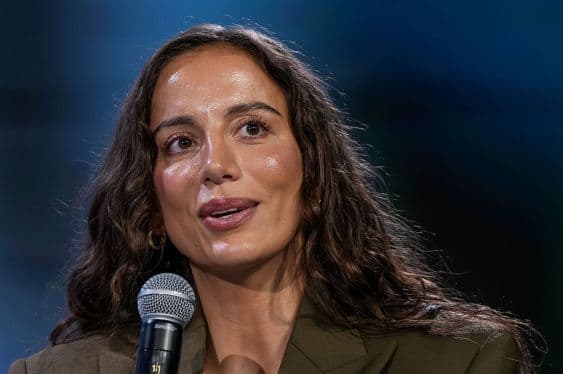
Mira Murati isn’t a natural creature of the conference stage. As the CTO of OpenAI, she was present but rarely the public face of the company. As CEO of her own company, Thinking Machines Lab, she has been even harder to find. So when she sat down with Bloomberg in San Francisco on Thursday — her first major media appearance in roughly 18 months — it was worth paying attention, even if she was careful not to say too much. The timing makes sense. Thinking Machines has spent the better part of a year and a half operating largely in the background: raising capital, hiring researchers, and shipping one product,Tinker, an API for fine-tuning open-source AI models. In the meantime, the companies competing for the same talent, customers, and headlines have only grown more omnipresent. OpenAI, where Murati spent six years as CTO, is constantly in the news cycle. Anthropic’s momentum is all that anyone can talk about right now. And xAI, Elon Musk’s AI venture, has been folded into SpaceX ahead of what is expected to be its massive public offering, generating its own gravitational pull on attention and investment. In that environment, staying heads down has diminishing returns; at some point, you have to make some noise just to remind the market you exist. Murati used the Bloomberg appearance to do exactly that and not much more. She previewed what Thinking Machines is calling “interaction models,” which she described as a fundamentally different kind of AI interface. Rather than the turn-based, prompt-and-response dynamic that defines most AI products today, she told interviewer Emily Chang, the company’s models are designed to process continuous streams of audio, text, and video in 200-millisecond intervals. The idea is that they can pick up on the texture of human communication — the interruptions, the mid-thought corrections, even pauses to think — in something closer to real time. But Murati was careful to frame it as a first step, not a finished product, and she declined to put a specific release date on anything. She also answered questions about the episode that first put her more squarely in the public eye: the chaotic week in November 2023 when OpenAI’s board fired Sam Altman and she became interim CEO. Inside OpenAI it came to be called “the blip.” Murati said she felt clear about her decisions in each moment — that protecting the mission and the team was the through-line that made the choices feel obvious even as the situation appeared to be falling apart from the outside. She said the company would have “imploded” if not for her involvement through that strange five-day stretch and its immediate aftermath. But she acknowledged that clarity of intent is not the same thing as clarity about consequences. In retrospect, she said, she would have pushed harder for more information, a better transition plan, and more transparency. What she did not say, at least not directly, is whether she thinks things turned out well. Asked whether she still trusts her former boss, she sidestepped the question, steering the conversation toward a larger concern that she returned to several times: the concentration of consequential decisions in too few hands — not just at OpenAI but across the industry. Her worry, she said, is less about the character of any individual leader (though she acknowledged that matters) and more about the absence of structural checks. Good people make bad calls. Well-intentioned organizations drift. Too much attention has been paid to virtue and too little to governance, she suggested. Chang also politely pressed her on the departures of several high-profile researchers from Thinking Machines in recent months , a subject Murati has largely avoided in public and that she downplayed on Thursday. First, she said, building a frontier AI lab from scratch compresses years of normal organizational volatility into months. She also acknowledged that compensation — the nine-figure packages that have become standard currency in the war for AI talent — captures people’s imaginations, but she suggested it isn’t usually the whole story. To some audience laughter, she said of her own competitive instincts, “When I wake up in the morning, I am not thinking about how to kill the competitor.” Naturally, Chang asked about what comes next for AI broadly, including for the humans who AI companies once said would be empowered by AI but who’ve more recently grown scared by talk of mass job displacement, not to mention a future where AI is used to create chemical weapons. Murati, who was born in Albania and speaks with a slight Eastern European accent, was measured in her response. She pushed back on the framing of inevitable dystopia or inevitable utopia, arguing that neither outcome is predetermined and that the period we’re in right now is the one that will determine which way things go. Still, she said — and not for the first time during the interview — that if humans take their hands off the wheel too soon, the future will look very different, and not better.

read more

Latest AI News

View All News →
India's Compliance Maze: How TeamLease RegTech Is Using AI to Tame a 13,000-Change Beast

India's Compliance Maze: How TeamLease RegTech Is Using AI to Tame a 13,000-Change Beast

Enterprises in India face up to 11,000 compliance instances annually from over 3.2 million regulatory websites. TeamLease RegTech is deploying AI to shift compliance from reactive record-keeping to predictive, intelligence-driven risk management for businesses nationwide.

1 hour ago

View

Meta Strikes Fresh Data Centre Agreements With Crusoe: Report

Meta Strikes Fresh Data Centre Agreements With Crusoe: Report

The latest deal reflects Meta’s ongoing efforts to expand its AI infrastructure as demand for large-scale computing resources continues to grow.

1 hour ago

View

Source: Elastic agrees to buy CRV-backed DeductiveAI for up to $85M

Source: Elastic agrees to buy CRV-backed DeductiveAI for up to $85M

DeductiveAI, a startup that uses AI to catch and resolve bugs in software, has agreed to be sold to enterprise software company Elastic for up to $85 million, according to a person with knowledge of the deal. Deductive, which was founded in 2023, came out stealth last November when it announced a$7.5 million seedround led by CRV with participation from Databricks Ventures, Thomvest Ventures, and PrimeSet.  The investment valued the startup at $33 million, according to PitchBook. Elastic and Deductive did not respond to multiple requests for comment. TechCrunch will update this article if either company responds. The sale marks a speedy exit for Deductive, which is operating in a fast-growing sector known as AI site reliability engineering (AI SRE). Building AI-powered SRE tools has become an important area, driven by the massive influx of AI-written code. Replacing manual debugging with AI enables human SREs to shift focus from constantly fixing outages and other problems, to spending more time on helping with product development. The acquisition reflects a broader trend in which established tech incumbents are looking to buy AI-native startups to integrate agentic technologies into their existing product suites, the source told TechCrunch. Elastic, which went public in 2018, is best known for Elasticsearch, the search and analytics engine that helps organizations store, search, analyze, and monitor large amounts of data in near real time. The company’s observability software — essentially tools that let engineers monitor software systems and detect security threats — could benefit from Deductive’s tech. According to the source, integrating Deductive’s AI technology into Elastic will enhance its observability platform by giving customers tools to automatically monitor performance and resolve system failures in real-time. Deductive was co-founded by Rakesh Kothari, who was previously VP of engineering at Lightspeed-backed business analytics startup ThoughtSpot, and Sameer Agarwal, who formerly worked at Apache Software Foundation and Meta. Agrawal was one of the founding engineers at Databricks. While Deductive reached roughly $1 million in annual recurring revenue (ARR,) according to the source, the startup’s growth lagged behind Resolve AI, one of the sectors’ perceived early winners. The two-year-old Resolve was co-founded by former Splunk executive Spiros Xanthos and Mayank Agarwal. Greylock and Lightspeed-backed startup was last valued at$1.5 billionwhen it raised a $40 million Series A extension in April.

5 hours ago

View

Almost half of U.S. singles feel negatively about AI in dating, Match says

Almost half of U.S. singles feel negatively about AI in dating, Match says

Dating app giant Match Group — which owns apps like Tinder, Hinge, and OkCupid — conducted astudyto determine how U.S. singles really feel about the relationship between AI and dating. Turns out, people don’t want AI messing with every aspect of human life. Across the industry, dating apps are experimenting with AI. Bumble introduced adating assistant named Bee, and Tinder isspendingso much on AI tools that it’s slowed its hiring process. Meanwhile, Hinge’s CEOstepped downlast year to launch a more AI-focused dating app altogether. But according to Match’s survey of 1,000 people aged 18 to 39, 47% of singles have a negative view of AI’s use in romantic contexts. This perspective varies depending on what the AI is being used for. About 40% of singles say they would refuse to date someone who uses an AI companion app, and that figure rises to 51% among women ages 18 to 24. However, only 12% of 18- to 24-year-olds said that they had used a companion app over the last three months, and only about a third of those users said they were seeking genuine connections with those chatbots. While Match says that people harbor a “near-universal” disapproval of actually dating an AI, like in the movie “Her,” that doesn’t mean that respondents are wholly opposed to AI features within apps. Some 64% of respondents said they could see how AI might help them in their dating journey. If we’re being pedantic,technically, every major dating app has already used some form of matching algorithm since before we knew what a GPT was. This survey refers to the new crop of AI features that basically every app is introducing, which help users punch up their profiles, choose photos, and keep conversations flowing. What dating app developers should take away from this survey is that people are not entirely closed off to AI; they just don’t want to be in a relationship with a robot, nor do they want to feel as though their dating experiences are overly inundated with technology that feels inauthentic. “Ask singles what they want from AI in dating, and the answer is pretty consistent: help with the hard parts, but hands off for the human parts,” Match wrote in a blog post. “Yes, they’ll use it to help them punch up a profile or for help figuring out what to say when a conversation goes quiet, but the actual connection is still theirs to create.” Hopefully, this message reaches dating entrepreneurs like Bumble founder Whitney Wolfe Herd, who suggested that dating app users could havepersonal bots that date other users’ bots. It’s pretty normal nowadays to say you met your partner online, but “his bot asked my bot out, and our bots hit it off” will never be a socially acceptable meet-cute.

9 hours ago

View

Submit your Tool

Submit AI Tools – The ultimate platform to discover, submit, and explore the best AI tools across various categories.

PoweredByAI.app is an AI Tools Directory helping individuals, businesses, and creators discover the best AI tools for writing, coding, design, productivity, and more.

© 2026 , Product of011BQ. All rights reserved.