Latest AI News

WWDC 2026: Craig Federighi Explains Apple's Decision to Launch a Siri AI App
Apple introduced a slew of AI features during the keynote address at the Worldwide Developers Conference (WWDC). Part of the Apple Intelligence suite, it announced several upgrades for Siri, the Cupertino-based tech giant's digital assistant. One of the highlights was the dedicated Siri AI app. The move marked a notable shift in strategy for Apple, with the company previously arguing against building a standalone chatbot experience. The decision was later explained by an Apple executive.
View
ChatGPT Could Soon Become an AI Superapp With Coding Tools and Agents: Report
OpenAI is preparing a major overhaul of ChatGPT as it seeks to expand beyond its chatbot roots and strengthen revenue generation ahead of a potential stock market listing. The planned changes will reposition ChatGPT as a broader platform that integrates AI agents, coding tools, image generation capabilities and third-party services within a single experience. The revamp is expected to begin rolling out in the coming weeks through updates to ChatGPT's web and mobile applications, while OpenAI also increases its focus on business customers and paid products.
View

From Clicks to Commands: How Enterprises are Abandoning the GUI for AI-Native Architecture
As autonomous AI agents replace human operators across enterprise systems, the graphical user interface is giving way to AI-native command-line architectures.
View

Zoho Launches India-Designed Server Nathu La, Claims 30% Lower Ownership Cost
Nathu La is based on Intel Xeon 6 processors and was built in collaboration with Intel’s engineering teams.
View

Meta Chooses Reliance for Its First AI Data Centre in India
The social media giant will lease 168 MW of capacity at a Jamnagar facility while backing nearly 1 GW of renewable energy projects across India.
View

ClickHouse Hires Databricks Veteran Ed Lenta to Lead APAC Expansion
The company also named Takeshi Kaneko as Country Manager for Japan. Kaneko previously led Nutanix Japan and held senior roles at Red Hat and Microsoft in the country.
View

Cambridge Scientists Test World’s First AI-Designed Universal Vaccine in Human
Researchers at Cambridge University say the technology could help prepare for future pandemics by enabling vaccines to target entire virus families before new outbreaks emerge.
View
Zoho’s Nathu La Redefines What a SaaS Company Builds
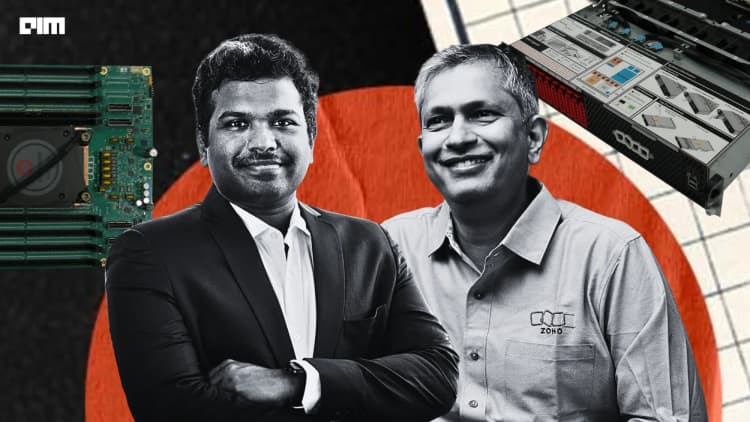
Zoho has already deployed 1,000 to 2,000 units of Nathu La in pre-production across its data centres. The company says the system is optimised for virtualisation, storage, HPC and AI inference workloads.
View

OpenAI Researcher Says AI Benchmarks Fail to Measure Frontier Model Capabilities
Noam Brown argues benchmark scores increasingly depend on inference compute, obscuring the true capabilities of frontier models.
View

Krisp Launches Real-Time Voice Translation API for Developers
The platform supports 61 languages and is designed to handle accented speech, background noise and industry-specific terminology in real time.
View

How Justin Ernest invested nearly $500M into hot startups without a traditional VC fund
Last year, Justin Ernest noticed a massive gap in how venture capital was working: Family offices and smaller institutional investors were eager to invest in the fastest-growing AI companies but couldn’t get access to those cap tables. Having spent over five years at Playground Global investing in deep tech and helping lead fundraising, Ernest was confident his connections to both investors and founders would allow him to bridge that gap. Instead of launching a formal VC fund, a process he says takes new managers anywhere from 12 to 18 months, Ernest used his network to secure allocations of stock in high-profile, later-stage companies. He then offers these individual deals to a group of about 30 smaller institutional investors using special purpose vehicles (SPVs), which act as single-deal funds. Over the last 12 months, his firm,Sabertooth Capital, has invested nearly $500 million into 10 companies, including Anthropic, Anduril, Base Power, Databricks, PsiQuantum, and SpaceX. The firm treats each deal as its own separate fund, in most cases structuring it as an SPV, in which the fund’s investors buy shares in the vehicle that owns the stock. He’s writing checks ranging from $10 million to $275 million — meaning he’s gaining significant chunks of shares — and always participating in official, company-approved funding rounds. Sabertooth is not the only firm offering family offices an opportunity to purchase equity in individual high-profile, late-stage startups. However, Ernest quickly raised a significant amount of cash from them because, in the sometimes-shady world of small allocations and SPVs targeting family offices, he’s earned a solid reputation. “Justin is authentically an investor,” said Benjamin Wagner, a CIO for a family office managing the wealth of 50 individuals. “He has judgment, he has expertise, he’s very technical, that really distinguishes him from other organizations that tend to, in my opinion, just trying to aggregate capital.” When Wagner tried to invest directly in PsiQuantum, the quantum computing startup last valued at $7 billion, the company’s CFO suggested that he invest through Sabertooth. “So, the first time I met [Ernest], I knew he was legitimate,” Wagner said. “Justin’s access is definitely different from some of these fly-by-night organizations.” That validation is extremely important. At a time when startups like Anthropic and Anduril are cracking down onunauthorized SPVs, investing through Sabertooth gives smaller limited partners some peace of mind. They know they are entrusting their money to an investor who is directly vetted and respected by the companies themselves. Beyond technical knowledge, the Harvard Business School graduate honed his communication skills after largely overcoming a childhood speech impediment. Ernest credits his ability to secure allocations of stock when highly coveted tech companies are raising to his wide network. “I’ve always found that my sort of superpower is being the nucleus of my network, and I like to use that and utilize that in a very strategic way,” he told TechCrunch. For instance, he can generally obtain investor capital for a new SPV from family offices on a tight timeline. “I have a captive set of LPs,” he said. “I can usually make four or five or six phone calls, and I know exactly what my LPs will commit.” Ernest told TechCrunch that for now, he wants to continue growing his business of raising funds for specific companies on behalf of his dedicated LP base. However, his ultimate goal is to eventually raise a traditional venture fund. That’s a difficult task, but he believes Sabertooth’s strong returns via these one-off SPVs to prove his track record, something investors care about most when deciding to back a new fund. He’s on his way with that wish. Sabertooth has already had one major big return from chipmaker Groq, which was licensed and acqui-hired by Nvidia for$20 billionlate last year. Next up is SpaceX’s highly anticipated IPO this Friday, along with Anthropic’s expected public listing later this year. They are poised to deliver an even greater windfall for his investors. But SPVs don’t have the same kind of street cred as traditional VC funds. Yet Ernest remains confident that starting with them, and earning a solid rep with family offices, rather than launching an emerging venture fund and duking it out with competitors was the right strategic move. “I wanted to be in the action,” he said. “I think this will end up being one of the best vintages of our lifetime.” Updated to reflect Sabertooth’s total capital deployed.
View

Google just fired a warning shot in the AI subscription price wars
Google just made its budget AI subscription plan a lot more budget-friendly, bringing a price war that’s been brewing in emerging markets squarely to American consumers. The company announced Monday that it is cutting the monthly price of Google AI Plus from $7.99 to $4.99 — while doubling the storage included at that tier, from 200 gigabytes to 400 gigabytes. Vikas Kansal, product lead for Gemini AI subscriptions,said on Xthat the storage updates would roll out to users over the next several days. Google AI Pluslaunched in Januaryas the most affordable paid AI subscription in the U.S. market, aimed at individual users and students rather than enterprise customers. Apparently that wasn’t cheap enough. It includes adecent feature set, too, including video generation via Omni Flash; the creative studio Google Flow; and NotebookLM, Google’s AI research assistant. For heavier users, Google also offers AI Pro and AI Ultra at higher price points and usage limits. The price cut is worth indexing on for reasons beyond Google’s own product roadmap. Subscription pricing hasn’t yet been a key battleground among AI providers in the U.S. But that’s changing in real time, suggests Chi-Hua Chien, co-founder and managing partner at consumer-focused venture firm Goodwater Capital; he sees Monday’s announcement as the next salvo in the commoditization era for AI infrastructure, pointing to Google’s structural advantages — vertical integration, distribution, the ability to bundle — as precisely the kind of force that’s likely to erode margins for purer-play AI providers over time. The historical parallel he reaches for is instructive. “If you look at the web era, the infrastructure companies were Microsoft, Cisco, Oracle, Northern Telecom, Lucent, Akamai, Equinix,” he told TechCrunch. “A lot of those companies survived for a period of time but aren’t worth a lot today.” The reason, he said, is that during every big tech shift — from PC to web to mobile — the infrastructure players “get commoditized very aggressively because the end customer doesn’t think, ‘Ooh, are my bits moving on Cisco networking equipment?’ They’re just thinking, ‘How do I move my bits as cheaply as possible?’” He sees the same dynamic coming in the not-too-distant future for today’s AI infrastructure layer — including the frontier model providers themselves. “My prediction for a lot of these infrastructure companies — and when I say infrastructure, I mean an OpenAI or an Anthropic, or the backend components, energy, chips, hosting — there will be a period of time when these companies are valuable,” he said. “But over time, you will see them get increasingly commoditized.” It’s certainly something that a bigger pool of investors will be pondering soon. Both OpenAI and Anthropic have filed confidentially to go public, and their ability to command premium valuations may soon be tested by exactly the kind of price competition Chien is describing. Thatcompetitionhas been building for nearly a year in markets like India, one of the fastest-growing AI user bases in the world. OpenAIdrew first bloodthere in August of last year, launching ChatGPT Go at roughly $4.60 a month — a fraction of its standard $20 Plus plan. Googlefollowed in Decemberwith a sub-$5 AI Plus plan of its own for Indian users. Monday’s announcement suggests the same logic that drove those emerging-market moves — undercut, bundle, and capture users before rivals do — has now crossed over to the U.S. market. Anthropic, notably, hasn’t followed. Unlike OpenAI and Google, it has yet to introduce localized pricing for India or a budget tier anywhere, a move that may become harder to avoid as its rivals keep slashing prices.
View