Latest AI News
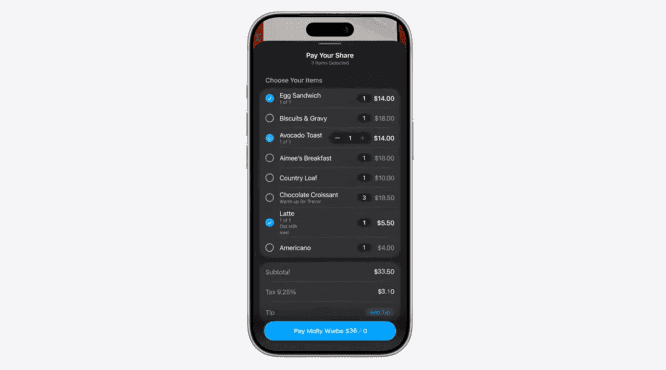
Apple is fixing the headache of splitting the bill with its new Siri in Camera feature
There’s nothing worse than going to a dinner with a big group of friends, opting out of drinking to save money, but then still having to pay for your friends’ espresso martinis when the group decides to split the bill evenly. You don’t want to come off cheapandmake everyone wait while you recalculate the bill. Now, Apple has a solution for this, which it unveiled atWWDC 2026. With the new feature, you can point your iPhone camera at a receipt. Then Siri mode in the Camera app will make each item selectable so that you can keep track of who got each item, and send people separate Apple Cash payment requests depending on what they actually ordered. Ideally, this feature should make bill splitting a less awkward and drawn-out experience. “If you’re grabbing a bite with friends and point your iPhone at the bill, then [you can] select what you ordered to split the tab with Apple Cash,” said Apple VP of Software Sebastien Marineau-Mes during Apple’s presentation. This kind of bill-splitting was already available with apps like SplitWise or Tab, but realistically, these products never got that popular (at least in my experience; no one has ever offered to use one of those tools). Since Apple’s payment features exist within the architecture of native apps like iMessage, it feels more organic to send someone a payment request through an app that they don’t have to go out of their way to download. You might also use another similar Siri mide in Camera feature while out to dinner — instead of pointing your camera at the bill, you can use it to see estimated nutrition information about the food you’re eating. Everything announced, from start to finish Siri AI’s update, explained All the new AI features coming to Apple Photos Apple Intelligence’s updates coming this year
View
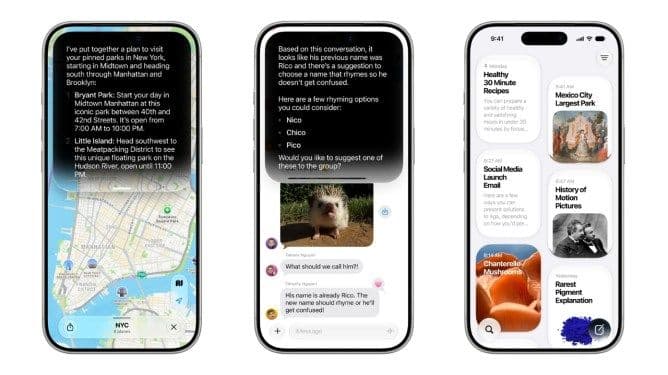
Apple gives Siri its own dedicated app
At WWDC 2026 on Monday, Apple unveiledthe new AI-ified version of Siri— in what has been called the assistant’s biggest and most dramatic transformation in the company’s history. In addition to thelaunch of its new Siri AI system, the personal assistant now has its own stand-alone app. The app is designed to serve as a warehouse of the user’s previous, archived conversations with the assistant. Much like the functionality of chatbots like ChatGPT or Claude, users can scroll through all of those previous conversations and re-visit a session. When a user opens a previous conversation, the app provides an overview of what was said so that users don’t have to read through the entire transcript. The app is also the place where users can launch a new conversation with the assistant. Siri now offers users a multi-function interface that mirrors other AI chatbots where users can enter text, upload documents and images, and access a voice mode, where you can speak directly to it. The Siri app is designed to give users access to the assistant across Apple devices, including iOS, MacOS, and iPadOS. All of a user’s Siri conversations are synced privately with iCloud, per Apple’s typical privacy protections. The dedicated app is obviously designed to give users a more organized way to interact with the assistant, as its powers become more extensive within Apple’s software. Everything announced, from start to finish Siri AI’s update, explained All the new AI features coming to Apple Photos Apple Intelligence’s updates coming this year
View
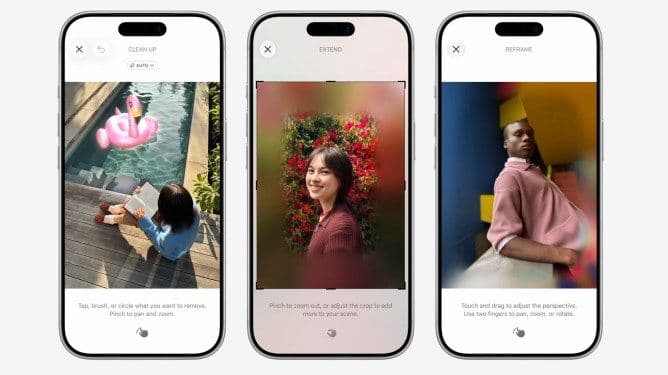
Apple’s Photos app is getting new AI editing features
Apple announced atWWDC 2026on Monday that its Photos app is getting a few new AI features thatleverage Apple Intelligence. A new spatial “Reframe” feature will let users use AI to reframe images. For instance, if a user accidentally captures a sign above someone’s head, if the photo would have been more symmetrical by stepping slightly to the right, or if eye contact with a subject was missed by a fraction of a second, the new reframing tool can help fix all of these issues. Users can touch and drag photos to adjust the perspective as if they had repositioned the camera in the original scene. Users can also preview the effect in real time. As the photo is being adjusted, a blur will appear around the edges of the original image, which will be filled later by Apple’s generative models. The feature only generates new content to fill in the gaps where the perspective has been affected to ensure that the reframe photo stays consistent with the original scene. The “Extend” tool expands images to give subjects more breathing room, or to straighten a crooked horizon without cropping out anything important. Users can pinch to zoom out, or adjust the crop to add more to the scene. The app’s popular “Cleanup” tool is also getting an upgrade so users can remove distractions with better quality and more realistic infill with generative AI. The feature lets users tap, brush, or circle what they want to remove. Everything announced, from start to finish Siri AI’s update, explained All the new AI features coming to Apple Photos Apple Intelligence’s updates coming this year
View

Apple’s Image Playground doesn’t suck anymore
Have you ever used the Image Playground app on your iPhone? Probably not — and you might not even know that your phone has a built-in AI image-generation tool. That’s because until now, Image Playground haskind of sucked, generating AI imagery that simply isn’t as high-quality as whatApple’s competitorscan make. AtWWDC 2026on Monday, Apple announced some necessary improvements to Image Playground. While we haven’t yet gotten to use the app, Apple’s presentation makes it seem like the company’s overall AI overhaul will make Apple Intelligence-powered apps, like Image Playground, perform a lot better. “From stunning nature scenes to fun images using multiple people from your Photos library, you can also transform your photos into endless styles just by describing what you want in natural language, and withprivate cloud compute, your photos are never stored or shared, even with Apple,” said Apple Senior Director Leslie Ikemoto in a WWDC presentation. As an example, Ikemoto explained that if you’re throwing a birthday party for your friend, you can design an invitation by using Image Playground to create an image of your friend holding a cake. Then, you can use natural language prompting to add candles to the cake or change your friend’s outfit. “You also have more ways to use the images you create, like choosing the right dimensions for what you’re working on, including a landscape image for your small business’s website, or a portrait image for your flyer,” Ikemoto added. Because Image Playground is integrated across your device, you can also use it to generate lock screens, iMessage backgrounds, contact posters, and more. AI art is generally pretty corny, but at least Apple won’t use your private photos for AI training, unlike many of itscompetitors. Everything announced, from start to finish Siri AI’s update, explained All the new AI features coming to Apple Photos Apple Intelligence’s updates coming this year
View
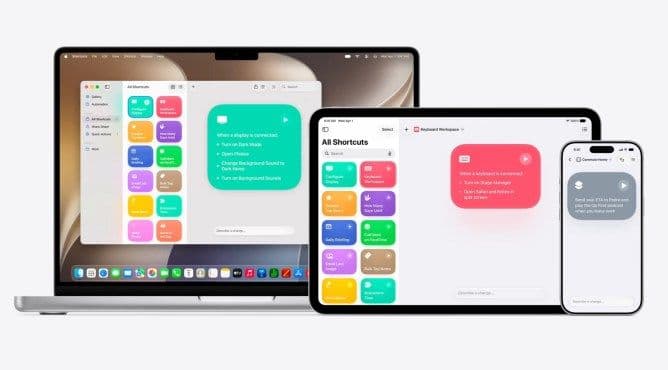
Apple will let you build workflows using AI in its new Shortcuts app
Apple has leveraged AI to make its visual-scripting tool, Shortcuts, easier to use in iOS 27,in a reveal shown at its WWDC 2026 event. The Shortcuts app was largely built for power users who wanted to automate repetitive tasks, create workflows, or set up multi-app actions. The new version of Shortcuts will instead allow users to write a prompt and simply describe what they want to do. The new feature is powered by Apple Intelligence, which helps to determine what a natural language description means so it can build out the required steps. “While super powerful, the process of creating these shortcuts can feel, well, complicated,” admitted Cecilia Dantas, senior manager of Home Software Product Marketing during Apple’s Worldwide Developers Conference keynote on Monday. The AI update makes the Shortcuts app more approachable and expands what non-technical people can do, as they’ll no longer need to worry about finding the right app actions or variables. Dantas also offered an example of how this feature could be put to real-world use, suggesting that users could design a shortcut that would automatically notify their partner when they leave work and give them an expected ETA for their arrival at home. Instead of having to figure out how to build this type of automation, users could just type in a request, and Shortcuts would then pull together whatever system and app actions are needed. In this case, it would create an automation that runs the shortcut once the user leaves work — accessing a stored address — then calculates their ETA using Apple Maps, and sends the alert via Messages. Users can also make edits or changes by describing them, Apple notes. In the “leaving work” example, for instance, the user could edit it after the fact to start playing a favorite podcast, for instance. The updated version of Shortcuts will roll out with iOS 27 later this fall. Everything announced, from start to finish Siri AI’s update, explained All the new AI features coming to Apple Photos Apple Intelligence’s updates coming this year
View

Apple just taught your iPhone to finish your sentences, your photos, and your workflows
Apple today announced a slate of new Apple Intelligence updates across its apps atWWDC 2026, including tab management for Safari, one-tap password updating, cross-app context awareness, and AI-powered shortcut creation via natural language. Safari is getting AI-powered tab management that groups tabs by topic automatically. It can also suggest and add related tabs to an existing group. The company is also adding a page monitor to Safari that notifies you when it detects changes — useful for tracking prices, news stories, or anything time-sensitive. Apple said Safari can also create a custom extension using text prompts to modify a web page, a capability that until now required a developer. The company is adding a way to update compromised passwords with one tap, with Apple handling the process on your behalf through AI and Safari — no manual login required. Messages is getting AI-powered reply suggestions and a new ability to surface photos based on a text description, so you can find what you’re looking for without scrolling. In Calendar, users can now type in natural language to create an event — just mention the people and the time, and Apple Intelligence handles the rest. Perhaps the most consequential update for power users: Apple said the Phone app can now pull context from other apps like Mail and Messages mid-call. If you’re on the phone with an airline, for instance, it can surface your flight details from your email in real time. It’s Apple’s answer to Google’s similar “Magic Cue” feature, and suggests that the AI assistant wars are increasingly being fought at the operating system level — with your personal data as the differentiator. The company is also overhauling Shortcuts with AI-powered creation. Rather than manually stitching together a workflow step by step, users can now describe what they want in plain language and the app builds the shortcut automatically — effectively bringing vibe coding to the mainstream iPhone user. Image Playground is also getting a significant update, with easier natural-language editing and a new model capable of generating more photorealistic images. Users can tap, circle, or brush to select and edit individual objects, and can now adjust the dimensions of any generated image to fit different formats — a feature developers will likely use immediately once Apple opens image generation to third parties via a new API. The app is also gaining the ability to generate wallpapers and contact posters. Finally,Apple is updating its Photos cleanup toolwith improved infill and higher-quality object removal, and adding an AI-powered expansion tool that can extend the edges of a photo. A new feature called Spatial Reframing lets you reposition the subject or objects within a frame — using on-device spatial models combined with an image-generation model to fill in the new perspective convincingly. Apple says it works on older photos too, which means your existing library is now a potential target for this kind of retroactive editing. Everything announced, from start to finish Siri AI’s update, explained All the new AI features coming to Apple Photos
View
Apple bets cheaper AI will woo small developers
Apple is hoping to draw in newer developers with lower AI infrastructure costs, the company announced during its developer keynote at its Worldwide Developers Conference on Monday. The tech giant said that developers with fewer than 2 million first-time App Store downloads will be able to use itsFoundation Modelsrunning inPrivate Cloud Compute, with no cloud API cost. “It’s access to frontier-tier level intelligence with unparalleled privacy protections, because getting started exploring ideas shouldn’t be held back by infrastructure costs,” the presenter noted. The “under 2 million” figure is another means of capturing the indie developer audience, similar to Apple’s efforts with theSmall Business Program, where the company offers lower commission rates to smaller developers who are just starting to build their applications and aren’t yet earning millions. Apple also noted that the Foundation Models framework is expanding this year to include image input and support for server models. That means the API can now integrate with the cloud model provider of developers’ choice, to ensure getting started with a large cloud model is as “accessible as possible,” as needed for more complex tasks, said Apple. The move reflects a growing reality in the AI industry that experimentation is no longer cheap. By waiving infrastructure fees for smaller developers, Apple is positioning its models as a lower-cost alternative for those developers who don’t want to take on additional cloud bills. Small developers aren’t the only ones tightening their belts these days. Tech giants likeMetaandAmazonhave discontinued their internal AI token usage leaderboards, where developers once competed to burn cash by experimenting with AI tools. Uber, meanwhile, recentlysaidit had run through its 2026 AI budget in just four months, news that some have taken as a need for more fiscal responsibility when it comes to AI.
View
Apple plays catch-up at WWDC
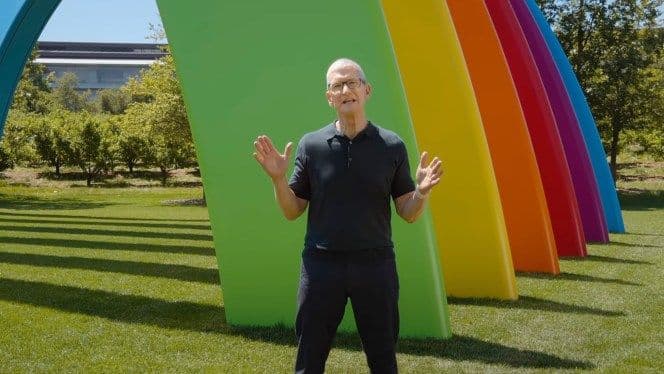
Apple’s Worldwide Developer Conference on Monday started off with an apology of sorts. Instead of jumping right into the headline news about arevamped AI-powered Siri, Apple’s senior vice president of Software Engineering, Craig Federighi spent the first stretch of the keynote on a list of repairs. For the past two years, Apple has been racing to catch up in AI while frustrations with its core software quietly added up: a design overhaul users hated, a search function that barely worked, a file-sharing feature that routinely failed, and a Health app that ignored half its user base. Apple didn’t say any of that on Monday. But the structure of its WWDC keynote said it for them, leading with fixes before features, and framing a better Siri as one item on a long list of improvements rather than the main event. At minimum, the sequencing suggests Apple believes the foundation needs shoring up before it can credibly ask users to trust it with something as consequential as AI. “Instead of just introducing a host of new features, we’re also taking the features you already rely on and making them even better, because we believe the best operating systems aren’t just built on big breakthroughs, they’re built on sweating the details,” Federighi said. It’s the kind of statement that would be unremarkable from most companies, but from Apple, it was as close to an admission of fault as you’ll get. (Sweating the details is exactly what critics said the company had stopped doing.) Federighi didn’t have to wait long to prove the point. The first item on the list was the company’scontroversial Liquid Glass designlanguage that first arrived in iOS 26 and promptly triggered consumer backlash over readability and usability concerns. While visually impressive, Liquid Glass’s glass-like aesthetic made certain on-screen elements harder to see. Users pointed out numerous ways the update was undercooked, particularly on the Mac, and begged Apple for tools to restore the more frosted look. The company approached the moment carefully, saying “really appreciates” the user feedback it received over Liquid Glass over the past year. “While we think this is a great new default look, we also know that some users would like Liquid Glass to be even more clear, and others prefer a more tinted appearance,” said Apple’s director of human interface design, Shubham Kedia, during the keynote address. (Nobody, for the record, is asking for it to be even clearer.) Apple, which had alreadytweakedthe design before today, is now allowing users to dial it back entirely with a new slider that goes all the way to “fully tinted.” A few other small but telling updates followed. Apple showed a “more uniform” toolbar in macOS designed to better distinguish controls and text from the content beneath them, in another usability improvement. App icons received additional Liquid Glass refinements to make them “sharper and more defined,” even when set to clear mode. Then came performance improvements. iPhone and iPad apps now launch 30% faster, new photos appear up to 70% faster in your library, and files are transferred up to 80% faster when using AirDrop, a notoriously flaky file-sharing system. In a subtle acknowledgment that people are holding onto their phones longer these days, Apple said it extended performance improvements to all models back to iPhone 11, a phone released in 2019. Apple also addressed several long-standing friction points: smoother transitions between Wi-Fi and cellular, a new indicator that lets you know when your messages are taking longer to go through (useful when you’re on low bandwidth or sending a large file), and a rebuilt search experience that the company describes as “more stable, more efficient, and more comprehensive of content.” New content will be indexed almost immediately, and a new ranking system in Mail will surface the most relevant results appear first. (The fact that this needed fixing at all says something about how far Apple’s search had fallen behind.) Apple’s Health app — which had gone years without meaningfully supporting half its user base — addedsupport for perimenopauseand menopause tracking. It’s a long-overdue move that arrives as the menopause care market hits its stride: earlier this year, menopause telehealth startup Midi Health crossed a $1 billion valuation, and dedicated investment in the category topped $294 million between 2022 and last year. iCloud shared photo albums can now accept contributions from Android and Windows users, making the feature far more useful for shared trips and group events. Apple also rolled out improvedscreen time controls for parentsbefore turning to the main event: theannouncement of the AI-enhanced Siri. The sequencing was intentional. By stacking a long list of smaller improvements up front, Apple reframed itsSiri updateas one piece of a broader effort, rather than the make-or-break AI moment the industry has been watching for. That framing is probably smart. Siri is launching into “beta” for consumers later this year, but not in the EU or China, where Apple still has regulatory hurdles to clear. For a feature that was supposed to define Apple’s AI strategy, “beta, coming later, not everywhere” is a pretty noteworthy hedge. Apple outlined other smaller AI advances, like how Apple Intelligence will be able to organize your webpages’ tabs, analyze webpages for information, check pages for updates, and more. You can even generate a custom Safari extension on the fly using AI, which sounds interesting. Passwords and Safari can now work together to suggest and apply stronger passwords automatically. Apple Intelligence is also adding helpful reply suggestions in Messages based on conversation context. For instance, if someone asks you for photos, Apple’s AI can point you to the right ones. Calendar can now create events from natural language commands — something third-party apps like Fantastical have offered for years, which makes this a catch-up feature. And AI will be able to surface key information when you make a phone call, like a confirmation code when calling an airline. Meanwhile, the Home app will use AI to summarize events, catching up with companies like Amazon and Google, which have moved on to more advanced territory, things likefire detectionandfacial recognition. (We’d like to thank Apple for staying away from the latter, however.) Image Playground — Apple’sAI image generation app— appears to have finally crossed the threshold from novelty to useful. Earlier versions produced images that were kitschy and difficult to apply practically; the updated model can generate something as functional as a business flyer or a cleanly edited photo. Apple also announced it will open image generation to developers via an API, a move that turns a consumer feature into a potential platform. AI can also nowedit photosmore substantively — removing distracting items from a scene or expanding its edges using generative models, similar to what Google Photos offers. The standout is Spatial Reframing, which lets you adjust a photo’s composition after the fact using Apple’s on-device spatial models. It even works retroactively on photos already in your library, meaning years of existing images are now fair game.
View

Following Anthropic, OpenAI files confidentially for IPO
ChatGPT-maker OpenAI has filed confidentially for an initial public offering, the company said Monday in ablog post.The filing comes a little more than a week after its main rival, Anthropic,also filed to go public, ramping up the race between the two AI firms. OpenAI, which was last valued at$852 billion post-money, submitted a draft registration statement to the U.S. Securities and Exchange Commission for a proposed IPO. The company didn’t list the number of shares or set a price. The filing is the latest signal that 2026 will be a blockbuster year for the public markets, withElon Musk’s SpaceXalso poised to make its debut at a $1.75 trillion valuation. OpenAI is racing to IPO even as it recently missed its own targets for new users and revenue,per The Wall Street Journal. Chief Financial Officer Sarah Friar reportedly expressed concern that OpenAI wouldn’t be able to support its massive spending on data centers. And the burn does appear to be massive. In late March, OpenAI secured $122 billion in the largest funding round in Silicon Valley history — $3B of which came directly from retail investors via bank channels. But the firm is poised to spend the size of that round on computing power for AI research in 2028, and expects to burn $85 billion that year even after doubling sales from the year prior,per The Wall Street Journal.The company does not expect positive cash flow until 2030. SpaceX’s AI spend, while not as large, provides another example of how the cost to train large language models can exceed the revenue companies bring in from those models. Anthropic, on the other hand, has provided investors with a much rosier picture of its financials, saying that it is close toachieving its first quarterly profit.That said, with a recent$65 billion funding roundand another$36 billion in chip-allocated debtpotentially on its way, Anthropic’s burn rate isn’t exactly modest. The confidential IPO filing allows OpenAI to start its preparation for a public offering without publicly disclosing detailed financial information or business risks, which is why the company hasn’t shared stock pricing or how much it hopes to raise yet. That said, the secondary markets provide a glimpse into what investors are willing to pay. Anthropicrecently surged to a $1 trillionvaluation on Forge Global, a retail secondary market platform, surpassing OpenAI, which was recorded at around $880 billion in April. David Shapiro, founder and CEO of OpenVC, oversees the NYSE OpenVC 500 Index, which tracks the largest public and private companies in the U.S. He said Anthropic’s rate of appreciation far exceeds OpenAI this year — 123% year-to-date versus OpenAI’s 11.3%. That said, despite Anthropic’s clear boost, OpenAI isn’t seeing a lack of secondary interest. “From a secondary investor standpoint, OpenAI had already grown into a significant portion of its valuation,” David Shapiro, founder and CEO of OpenVC, who oversees the NYSE OpenVC 500 Index which tracks the largest public and private companies in the U.S., told TechCrunch. “We haven’t seen OpenAI crater or anything close, and valuation is still enormously successful, according to the index.” He added that OpenAI’s stock in the secondary market “experienced a slight pop over the last few days, indicating investors may be pricing both as the ‘dual winners’ of the broader LLM race.” But the race to get to the public markets first is a real concern.Experts saywhoever makes their debut first will likely nab more of what is becoming increasingly scarce capital for AI companies, much of which will have already gone to SpaceX which is expected to IPO first among the three. Additionally, Anthropic’s filing disclosures will set a valuation comp that constrains how OpenAI can price its own offering when it files, according to a recent PitchBook report that viewed OpenAI as overvalued relative to its fundamentals. OpenAI, which was founded in 2015 as a nonprofit research lab, disrupted the world of AI when it released ChatGPT in 2022, sparking a wave of large language model advancements across the industry. While OpenAI has expanded its products to accommodate enterprise and government customers, the firm has a strong reputation of being more consumer-focused than rival Anthropic. The company has built real scale, with around900 million weekly active users. The IPO comes after significant internal struggles within the company. In 2022, OpenAI’s boardousted Altmandue to a lack of transparency from and trust in the CEO to stick to the firm’s mission of benefitting all humanity. Altman was quickly reinstated, and those who were involved in the coup, including co-founder Ilya Sutskever, departed shortly after. More recently, OpenAI has been involved in several lawsuits, including a recent one from thestate of Floridaaccusing the company and Altman of harming children by providing information to school shooters, offering guidance on self-harm, and addicting young users. Florida’s complaint adds to thelitany of lawsuitsagainst OpenAI and other chatbot makers following user delusions, self-harm, suicide, and mass casualty events. Last month, OpenAI went to trial after Elon Musk, one of its co-founders and competitors, sued the company and Altman alleging they violated a promise to keep the company a nonprofit. The case wasultimately tossed outafter a jury and judge found Musk was beyond the statute of limitations when he filed the case in 2024. OpenAI has also faced criticism after its president Greg Brockman and his wife each donated $12.5 million toLeading the Future, a pro-AI PAC dedicated to thwarting local politicians advocating for AI regulation. They made similar contributions to MAGA Inc., the pro-Trump super PAC. OpenAI has tried todistance itselffrom its president’s “personal” donations, claiming that none of the funds were provided on behalf of the company.
View
WWDC 2026: What to expect, from Siri’s highly anticipated revamp to Apple Intelligence and iOS 27
As Apple WWDC 2026 approaches, the excitement is building around what Apple has in store for us this year. From Siri’s overhaul to new Apple Intelligence updates, there’s a lot to look forward to. The annual Worldwide Developers Conference kicks off today at 10 a.m. PT/1 p.m. ET. For those eager to tune in, the event will be streamed live via theApple Developer app,Apple’s website, and theAppleYouTube channel. The most anticipated announcement is a major AI upgrade to Siri, transforming it into a more conversational assistant capable of understanding context, handling multi-step tasks, and interacting more naturally across apps and services. The revamped Siri will leverageGoogle’s Gemini technologyto enhance its capabilities. Additionally, recent leaks from Bloomberg have unveiled astandalone Siri appthat aims to compete with advanced AI chatbots like ChatGPT, Claude, and Gemini. Apple may also introduce a feature reminiscent of messaging apps, enabling users to set timers forautomatically deleting conversationsafter 30 days, a year, or keeping them indefinitely. According toThe Information, Apple plans to introduce an AI agent integration with the app store. While details are scarce, agents allow users to delegate tasks such as booking reservations, managing everyday tasks, editing documents, or controlling smart home devices. A new “Visual Intelligence” section isanticipatedto be introduced within the Camera app, taking the place of the previous Visual Intelligence feature found in the Camera Control button. This upgrade will introduce a dedicated Siri mode that exists next to options like Photo, Video, Portrait, and Panorama. The Visual Intelligence feature leverages Google Image Search to accurately identify objects captured by the user. In addition, the Photos app is set to receive exciting enhancements powered by Apple Intelligence. These may include intelligent scene recommendations for optimizing photos, automatic object removal for cleaner images, and an innovative AI photo editing feature that allows users to request edits simply by using natural language, new productivity functionalities in visionOS. Apple is set to upgrade the Image Playground app, introducing higher-quality image generation, more artistic styles, better character consistency, and richer editing controls. The interface for creating new images will be simplified, offering fewer controls and a “describe a change” option for editing. Additionally, we might see a suggested Genmoji feature that proposes custom emojis based on users’ media and text interactions. Users may also be able to generate AI wallpapers that reflect various themes and moods. Notable updates are rumored to be coming to the Wallet app, particularly a new bill-splitting feature that will simplify sharing expenses among friends or family. Users will be able to photograph a receipt and generate payment requests to different parties effortlessly. Alongside this, the Wallet app will also include a “Create a Pass” option that enables users to generate digital passes from physical items such as movie tickets, concert passes, or gym membership cards. Apple is expected to enhance its AI-powered Siri experience across its devices, as well as likely incorporate more AI features and stability updates. Keep tabs on everything that Apple reveals via the embed above, and see just how many of the expected announcements end up becoming a reality, and whether the much-anticipated Siri update really does live up to the hype.
View

Amazon now lets you design custom merch using AI
On Monday, Amazonintroduceda new feature that allows anyone to design merchandise using AI, posing an expanded challenge to online merch platforms like Redbubble, Bonfire, Spring, Fourthwall, and others. The company announced that people are now able to create new products using AI prompts via the Alexa feature in its Shopping app. In doing so, anyone can turn their idea into a design that can be featured on items from apparel to tumblers and more available through Amazon’s print-on-demand service, Merch on Demand. The service could be useful for printing one-off designs — like T-shirts for a family reunion, a personalized gift of some type, or to create products featuring a portrait of your dog, Amazon suggests. (Artists whose work has been used to train AI models may be less enthusiastic about this type of idea, of course.) After prompting to create the design, Amazon handles the production and delivery of the items through Prime shipping, the company says. The move puts AI-generated merchandise directly inside Amazon’s Shopping app, lowering the barrier for consumers who want to turn ideas into physical products but lack traditional design skills. While typically, print-on-demand businesses have catered to creators and various organizations, Amazon’s new feature could make AI-designed merchandise become just another shopping option. Currently, the option is only available in the U.S., Amazon notes. It is free to use the feature, as customers only pay for the products themselves. To use the feature, customers will tap the Alexa icon in the bottom right of the Amazon Shopping app or search “customize” in the search bar and click the drop-down option. This will take them into an experience where users can describe their idea to Alexa and see the design generated. Users can then edit the design by clicking on suggested actions or by typing in changes. Results can be shared with friends or family, allowing everyone to add the product to their own Amazon shopping carts. The full list of supported merchandise includes T-shirts, V-necks, long-sleeve shirts, polo shirts, quarter zips, jerseys, hoodies, sweatshirts, tank tops, raglans, tumblers, and water bottles.
View
WWDC 2026: Everything announced on Siri AI, iOS 27, Apple Intelligence and more
Apple’s WWDC 2026 event kicked off this morning at 10 a.m. PT at Apple Park, starting a weekfull of expected announcements around Siri, iOS 27, Apple Intelligence and more, along with developer events and demos. This year’s event is particularly notable for a couple things. It marks CEO Tim Cook’s last with the company, afterannouncing he’s handing things off to Senior Vice President of Hardware Engineering John Ternus September 1. And it’s expected to play host toApple’s attempt to give Siri and its AI efforts overall a big boostafterhanding some work off to Googleanddelaying some releases. Are they succeeding? Keep tabs on this page, and the rest of our ongoing coverage, to find out! As expected, Apple made the case for an improved experience with its longstanding Siri assistant, which it admitted faces greater expectations from users in the age of AI. With Google Gemini under the hood, Apple claims that the new Siri updates will more it more capable, conversational, compatible with visual intelligence, and it will be housed in a standalone app in addition to working across existing apps. Before rolling out the enhancements and features, Apple was adamant about its privacy-centric approach to AI. “We believe privacy in AI is non-negotiable,” Apple Senior Vice President Craig Federighi said during the stream, going so far as to say that “data is only used to execute your request, and outside experts can continue o verify this promise at any time.” If you were among those who weren’t exactly keen on last year’s Liquid Glass design updates,you weren’t alone. And while Apple isn’t switching to a new aesthetic,you are going to be able to dial back some of its elements, or really highlight them if you’re vibing with it.And for the app icon critics out there fresh from Spotify’s disco ball update, Apple showed off a new, layered approach to Liquid Glass within its apps. Claiming that its upcoming update will be “available to more users than any iOS release ever,” Apple revealed that all devices from the iPhone 11 onward will be eligible for their upcoming software update. And that update comes with a flurry of performance improvements it’s touting across a number of its OS releases this year, with Apple claiming that new photos will appear 70 percent more swiftly, AirDrop transfers will be 80 percent faster and CPU schedulers will be improved to help multitasking. And for everything else that’s coming around the bend, you can stay tuned right on this page and watch the full event via the stream above oron Apple’s YouTube page right here.
View